
The Trans Prefix
Trans philology, trans-trans difference, and literal metamorphosis.
Jacob Hale’s Suggested Rules for Non-Transsexuals Writing about Transsexuals, Transsexuality, Transsexualism, or Trans____. begins with a list of things someone who isn’t trans might write about. Transsexuals: a type of person. Transsexuality: a state of being that a person can inhabit. Transsexualism: in my read, distinguished from the former as a less individual, more social phenomenon; the cultural paradigm that allows for the condition of transsexuality, of being “a transsexual.” And then, “Trans____:” a catch-all for different words, specific to their own “temporal and cultural location[s],” that orbit transsexuality, what the late ‘90s academic milieu that became trans studies speaks as, to, and about.
There is a real comfort in lists like these, and they appear in early modern writing often. The list form conveys a sense of comprehension, even exhaustion, without making any direct claim to be doing so. The blank “____” of the final trans emphasizes that exhaustion—both as a commitment to exhaustive coverage and as a tired acquiescence to all the many types of trans articulations of the past, present, and future.1
Before the list begins, Hale adds an addendum on language:
Note that the list refers to transsexuality rather than to transgender per se. However, many items also apply to non-transgendered researchers writing about transgender, as well as to trans-folk writing across trans-trans differences.2
This paragraph contains an even greater variety of terms with rich “temporal and cultural” associations. Transsexuality and transgender are put into a fragile but peaceable alliance, giving limited permission for analogy. The uses of “non-transgendered” and “about transgender” stand out as dated but harmless conversions of trans terms into past participle- and noun-forms that have been left behind for the streamlined adjective form. Then we reach the more vernacular “trans-folk:” here the prefix-form of trans does not draw us to the absence of modified term (as “Trans____” does) but rather fills the gap with what Talia Mae Bettcher calls “folk personhood” or “people-as-folk”—that is, with a broad collective of people regarded as individuals with interpersonal capacity.3 The release of the trans prefix from its attachment to any particular word is only emphasized in the elegant expression of “trans-trans differences.”
“Be aware,” Hale writes, “that words are very often part of conversations we’re having within our communities, and that we may be participating in overlapping conversations within multiple communities.” Indeed, the opening of this guiding document encapsulates some of the conversations afforded by trans____, both in its prefix and its gap. That is, what trans can mean; what it doesn’t, can’t, or shouldn’t; what it did not, but may; and what it does not yet, but perhaps will.
What types of trans words really do what we need them to do when we talk as, to, and about trans-folk? In “Toward a Trans Philology,” Joey Gamble’s excellent article on the relationship between early modern encyclopedic archives of “trans-” sex/gender change and late nineteenth-century sexology, he writes, “It is not difficult to imagine an alternate world, a history that could have been, in which gender variance was marked in English not by ‘trans’ but by some other word or words.”4 I think this (correct) assessment leaves those of us invested in philological and literary history in a bit of a bind. There is nothing inherent in the word trans that makes it what people who change their sex/gender need to be called, at least any more than another word in its orbit. Is that something we can accept?
I’m thinking about this question as I have chosen to describe my dissertation project as “discourses in early modern natural philosophy in relation to the history of transition.” I chose the word transition for a couple reasons. One, I am interested in the mechanism of change specific to trans life and experience as different natural philosophical arguments allow or occlude it. Two, I have found myself curious about the lack of consensus in trans studies on a contemporary definition for transition, and I believe my research can shed light on new ways to consider what transition is and is not, or can be, and what it means to whom. Three, I argue that “transition” is a mechanism of change distinct from change-in-general, as well as early modern descriptions of “transformation” and “metamorphosis,” yet is crucial to debates in early science and materialism, particularly when it comes to taxonomy, species-form, and the agency of matter in relation to Nature and God. (What Gamble describes as “the potential for a radical self-transformation—a potential to leave behind the wheat-ness that had been assigned to it at birth and to live its life as darnel, a completely different grain,” is a clear example of how such natural philosophical discourses of transition manifest.5)
In the 1993 first issue of GenderTrash from Hell, a trans zine recently republished by LittlePuss Press, Xanthra Phillippa includes a list of “TS Words & Phrases.” Her list is a shining example of what Gamble describes as “trans people, both inside and outside the academy, […] practicing a form of philology […] and […] some of the most vital forms of ‘textual’ criticism”—or, rather, what Hale calls those “conversations we’re having within our communities.”
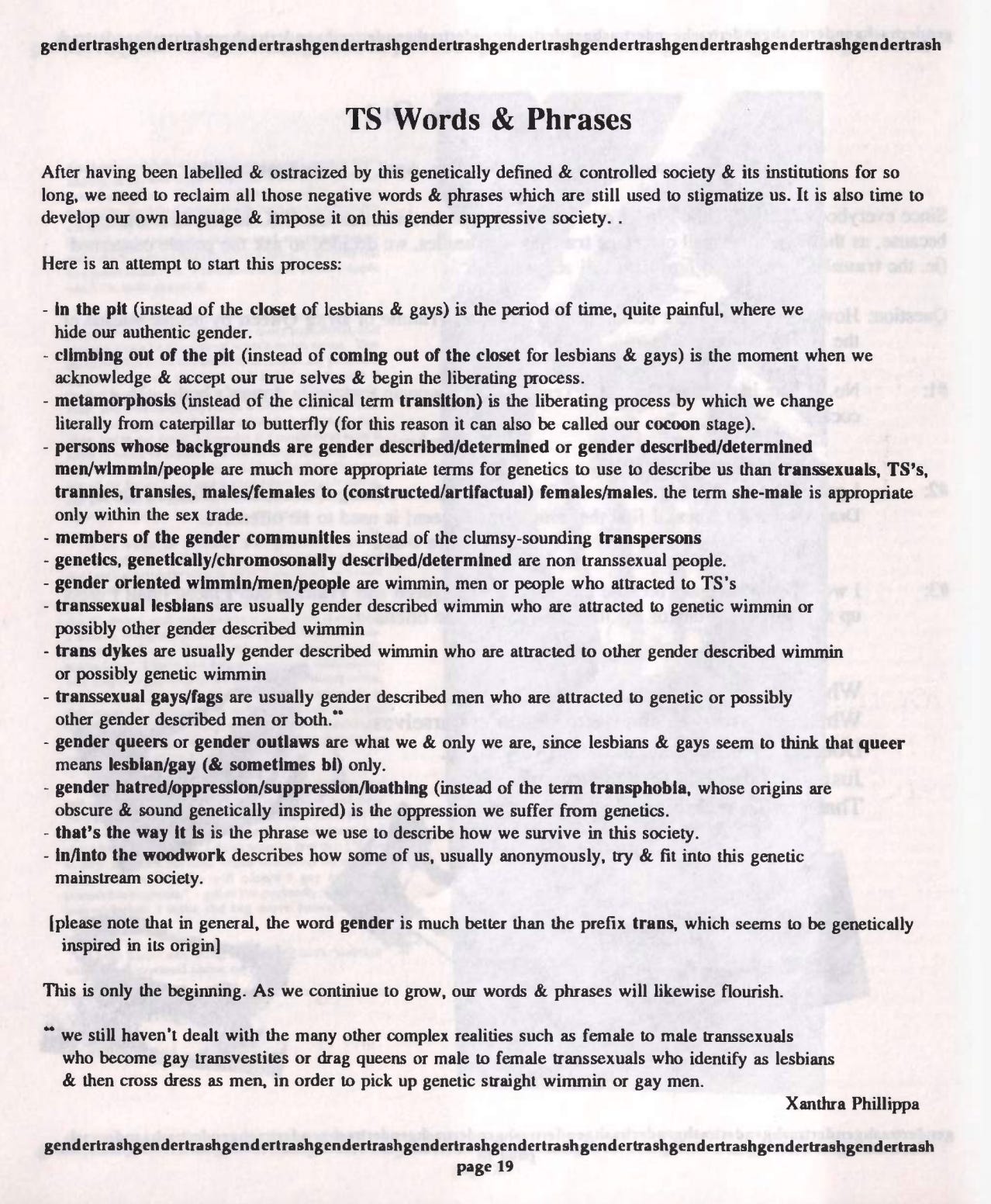
In a bracketed note at the bottom of the page, Phillippa critiques the ubiquity of the “trans” prefix. She writes, “the word gender is much better than the prefix trans, which seems to be genetically inspired in its origin.”6 Philologically, this argument may seem ironic, as “gender” and “genetic” are directly etymologically related. In historical and political terms, however, her skepticism of “trans” is evidently steeped in deep knowledge of and experience with the language used in clinical and institutional settings to pathologize trans life and block access to transition care and resources.
Indeed, when it comes to transition, she explicitly opts for an arguably early-modern term:
metamorphosis (instead of the clinic term transition) is the liberating process by which we change literally from caterpillar to butterfly (for this reason it can also be called our cocoon stage).7
This is, in my opinion, a brilliantly conceived definition. Its focus on transition as liberating is wonderful enough on its own. But it is Phillippa’s non-metaphoric metaphor, the insistence on literalism in conjunction with language derived from the life-cycle of an insect. that challenges not only the definition of transition but the boundaries of definition itself. Like the liberating process of transition/metamorphosis, words are liberated from their meanings. The metaphor form undergoes its own metamorphosis. Gamble speaks of philology through Werner Hermacher’s definition “transcending without transcendence,” but I think Phillippa has come close here to transcending the constraints she finds in trans.8
But what do we make of Phillippa’s (admittedly unsuccessful) eschewal of the trans prefix? Gamble cites trans as “historically overdetermined,” but perhaps that is the very reason it has such staying power.9 Perhaps we will land here once again in trans studies’ favored affect: ambivalence.
There’s one more connection I want to draw between Hale, Gamble, and Phillippa—their interest in, as well as pragmatic mobiliziation of, perpetuity. The perpetual is cousins with the proliferative and multiplicitous, but it has an added temporal dimension.
In Hale, the blank in “Trans____” invites the reader to fill in the next iteration of philological production and critique, relying on the prefix as a glue without giving up the specificity of descriptiveness. In the words of Hale’s ninth rule, it “undermine[s] paradigmaticity,” calling to “make […] explicit” who we are—and are not—talking to, about, and with.
In GenderTrash from Hell, Phillippa ends her glossary page, under her bracketed trans critique, with a more explicit gesture to the future. “This is only the beginning,” she reminds us. “As we continue to grow, our words & phrases will likewise flourish.”
Gamble’s conclusion on trans philology likewise echoes these sentiments. “To wit: there is not one sex/gender system, but a multiplicity; not a stable multiplicity but only a perpetual multiplication of sexes and genders. Trans is the perpetual extension of elements of gendered existence”—perpetual, Gamble explains, denotes “a process without a set product.”10
Consider these OED definitions for perpetual:
1.a Lasting or destined to last for ever, eternal; never ending or ceasing. Also: for the duration of a person’s lifetime; (of a position, office, etc.) held or occupied until death, appointed for life; permanent. (a1325–)
2a. Continuing or continued in time without interruption or remission; repeated frequently or without cessation; occurring in endless succession; persistent; continual; constant. (a1382–)11
These definitions fluctuate between the scale of the lifetime and a grander eternity. Perpetual invokes both permanence and repetition, simultaneous action and continuity. Without remission, persistent, never ceasing.
“Trans is the perpetual extension of elements of gendered existence.” Or, in Hale: “Transsexual lives are lived, hence livable.”
Thank you.
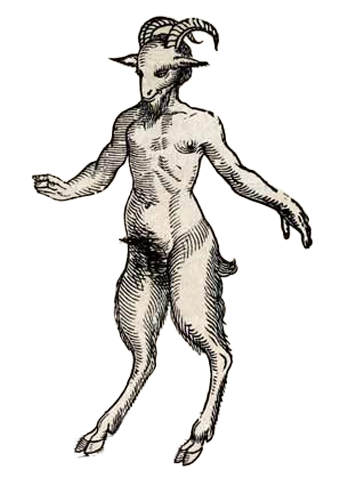
“All identities by all age groups.” Gender Census 2025. https://docs.google.com/spreadsheets/d/1qHpnz4lUthzJX4eEPvGCelR_YHgbGa9i79cXWt7CzjQ/edit?gid=109101990#gid=109101990.
See full the report here.
Jacob Hale. Rules for Non-Trans Writing About Transsexuals, Transsexuality, Transsexualism, or Trans ____. 1997; updated 2009, https://sandystone.com/hale.rules.html.
Talia Mae Bettcher. Beyond Personhood: An Essay in Trans Philosophy. University of Minnesota Press, 2025, 259; 262.
Joseph Gamble. “Toward a Trans Philology.” Journal for Early Modern Cultural Studies, vol. 19, no. 4, 2019, pp. 26–44, 29.
Ibid, 28.
Mirha-Soleil Ross and Xanthra Phillippa McKay. GenderTrash from Hell, issue 1, vol. 1, April/May 1993, 19.
Ibid.
Gamble, “Toward a Trans Philology,” 36.
Ibid, 29.
Ibid, 36.
“Perpetual,” Oxford English Dictionary, Oxford UP, December 2025.